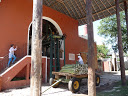
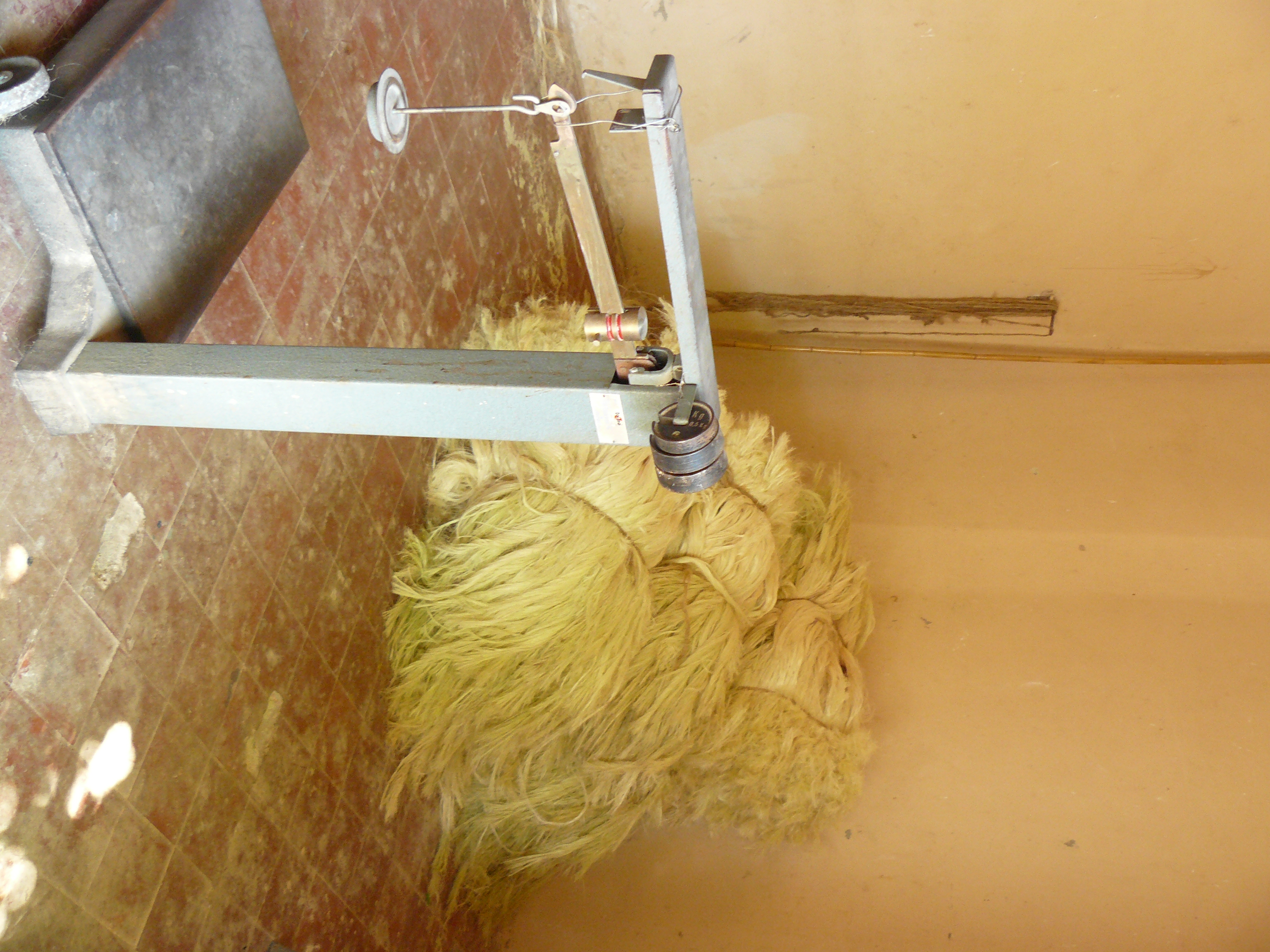


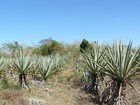
Coming from the eastern part of Mexico, the name of Sisal (Agave sisalana) ou « henequen » , come from a small port town on the cost in the Yucatan area, Sisal, from where the fibre was sent round the world, in the glorious time.
The fibre is still used for making ropes, twine, string, cord, fabrics and carpet.
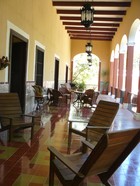
Cultivated by major owners, the henequen became fibre for twine and ropes or other products. Some of this beautiful “Haciendas” are now converted to “ live museum” like “Sotuta de Péon” near Mérida in Yucatan.

In the old days, the leaves were picked (cut) by hand, paths through the plantation were equipped with rails pulled by horses to facilitate the harvest and pull carts back to the factory.
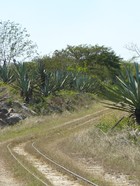
Then the leaves were processed by special machines to extract the fibre.
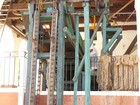
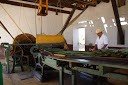
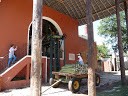
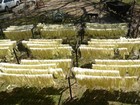
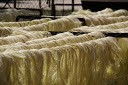
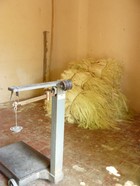
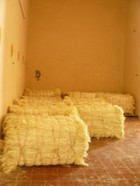
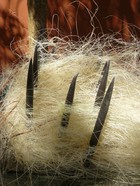
Each leave, looking like a pack of fibre was dried in the sun, before being packed like a bale of fibre and sent away as raw material, or being processed in the plantation to become ropes and twine.
The fibre was separated by hand through hooks, before being processed by torsion.
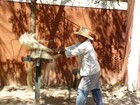
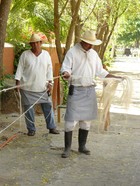
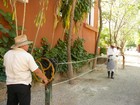
The yarn’s thickness depends on the number of fibre used, and the thickness for the rope on the number of yarn used in the process.
Machines finish the job to spine the yarn and produce bobbins ready to use.
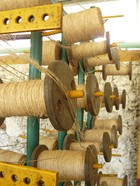
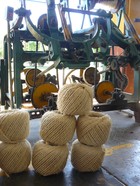
This activity was very prosperous and helped the economic development of the Yucatan area. Until the sixties, the production was up to 160 000T/ year, before declining in the seventies. The use of the nylon fibre had become so popular, that the sisal activity collapsed.
Today the sisal production has been taken over by South America, Brazil became the first sisal producer in the world with 130 000T/year, which is around 50% of the world production; African countries like Kenya and Tanzania are also sisal productor.
The use of sisal is not only for twine and ropes, but had been largely used for flooring as carpet or rugs, also as wall covering, reminding a real classic in interior design.
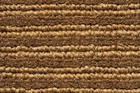
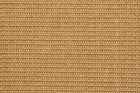
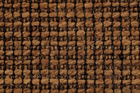
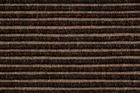
Credits photo: Ruckstuhl. www.ruckstuhl.com
Today sisal is also used in the paper industry, and for geotextile products, with some opening on new market as an ingredient to reinforce plastic composite materials for the automotive.
THM
Photo Credit : Therese Mace, Christophe Paquay

L'EXPO A NE PAS MANQUER A PARIS

ET CELLE CI AUSSI

Archives
-
▶ 2025
-
▶ 2024
-
Nov 2024
-
Sep 2024
-
May 2024
-
Feb 2024
-
Jan 2024
-
-
▶ 2023
-
Nov 2023
-
Sep 2023
-
Jul 2023
-
May 2023
-
Mar 2023
-
Jan 2023
-
-
▶ 2022
-
Sep 2022
-
Jun 2022
-
Mar 2022
-
Jan 2022
-
-
▶ 2021
-
Nov 2021
-
Sep 2021
-
Jul 2021
-
Mar 2021
-
Jan 2021
-
-
▶ 2020
-
Nov 2020
-
Sep 2020
-
Jul 2020
-
May 2020
-
Mar 2020
-
Jan 2020
-
-
▶ 2019
-
Nov 2019
-
Sep 2019
-
Jul 2019
-
May 2019
-
Mar 2019
-
Jan 2019
-
-
▶ 2018
-
Dec 2018
-
Sep 2018
-
Jun 2018
-
Apr 2018
-
Jan 2018
-
-
▶ 2017
-
Nov 2017
-
Sep 2017
-
May 2017
-
Mar 2017
-
Jan 2017
-
-
▶ 2016
-
Dec 2016
-
Nov 2016
-
Oct 2016
-
Sep 2016
-
Aug 2016
-
Jul 2016
-
Jun 2016
-
May 2016
-
Apr 2016
-
Mar 2016
-
Feb 2016
-
Jan 2016
-
-
▶ 2015
-
Dec 2015
-
Nov 2015
-
Oct 2015
-
Sep 2015
-
Jul 2015
-
Jun 2015
-
May 2015
-
Mar 2015
-
Feb 2015
-
Jan 2015
-
-
▶ 2014
-
Dec 2014
-
Nov 2014
-
Oct 2014
-
Sep 2014
-
Jul 2014
-
Jun 2014
-
May 2014
-
Apr 2014
-
Mar 2014
-
Feb 2014
-
Jan 2014
-
-
▶ 2013
-
Dec 2013
-
Nov 2013
-
Oct 2013
-
Sep 2013
-